



-
Product Categories
-
Featured Products
-
What Is the Tear Resistance of Rubber Conveyor Belts?
1. What Is Tear Resistance?
Tear resistance is an important mechanical property of rubber conveyor belts. It describes the ability of a conveyor belt to resist the initiation and propagation of cracks when subjected to sharp objects, concentrated loads, or mechanical impact.
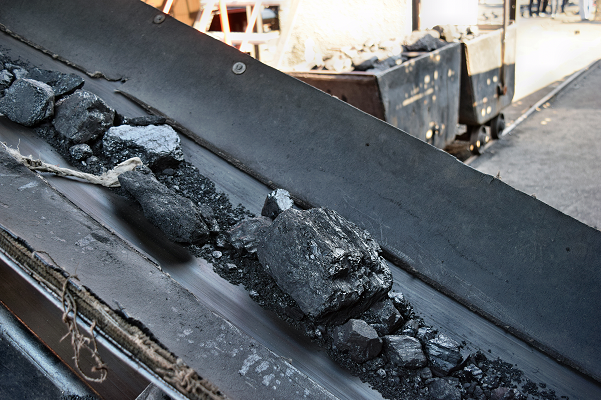
During operation, conveyor belts may carry sharp rocks, iron ore, coal, and other abrasive materials. These materials can penetrate the rubber cover and damage the internal carcass. Once an initial cut or puncture occurs, the crack may continue to extend along the belt, potentially causing serious longitudinal damage.
Tear resistance involves three related but different properties:
- Rubber Tear Strength: The ability of the rubber compound itself to resist tearing.
- Tear Propagation Resistance: The force required to extend an existing crack in a conveyor belt.
- Longitudinal Rip Resistance: The ability of the complete conveyor belt structure to prevent a local cut from developing into a long tear along the belt.
These properties should not be confused because they use different test methods and measurement units.
For heavy-duty mining applications, longitudinal rip resistance is particularly important because a small puncture can develop into extensive belt damage if the carcass cannot effectively restrict crack propagation.
2. Why Is Tear Resistance Important?
Conveyor belts operating in mining, steel plants, cement factories, and ports frequently encounter sharp materials and impact loads.
Common causes of conveyor belt tearing include:
- Sharp rocks penetrating the rubber cover during material loading.
- Large lumps of ore falling from excessive loading heights.
- Metal objects becoming trapped between the belt and conveyor structure.
- Insufficient transverse reinforcement allowing cracks to propagate.
- Poor bonding between rubber covers and the internal carcass.
A longitudinal tear can cause substantial production losses, particularly in long-distance conveyor systems.
Therefore, selecting a conveyor belt based only on tensile strength, cover thickness, and abrasion resistance is insufficient. Tear resistance should also be evaluated according to the actual operating conditions.
3. International Standards for Conveyor Belt Tear Testing
Different standards evaluate different aspects of rubber and conveyor belt tearing performance.
| Standard | Test Object | Main Test Property | Unit |
|---|---|---|---|
| ISO 34-1:2022 | Vulcanized rubber | Rubber tear strength | kN/m |
| ISO 505:2025 | Textile conveyor belts | Tear propagation resistance | N |
| ISO 4674 | Coated fabrics | Fabric tear resistance | N |
| ASTM D624 | Vulcanized rubber | Rubber tear strength | N/mm |
| ASTM D378 | Rubber conveyor belts | Physical properties and specified belt tests | Depends on test |
| MT/T 668-2019 | Flame-retardant steel cord conveyor belts for coal mines | Crack resistance and impact penetration strength | kN, J |
ISO 34-1: Rubber Tear Strength
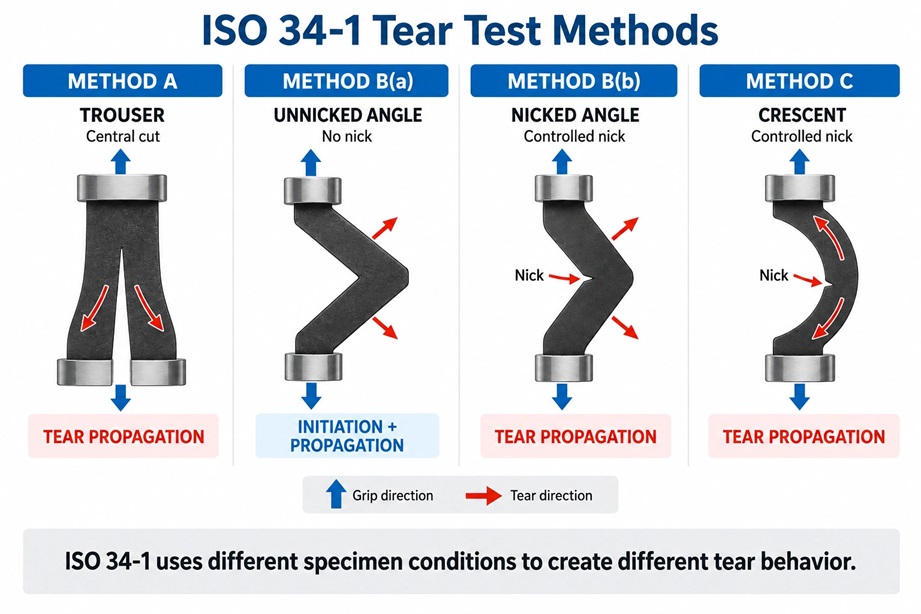
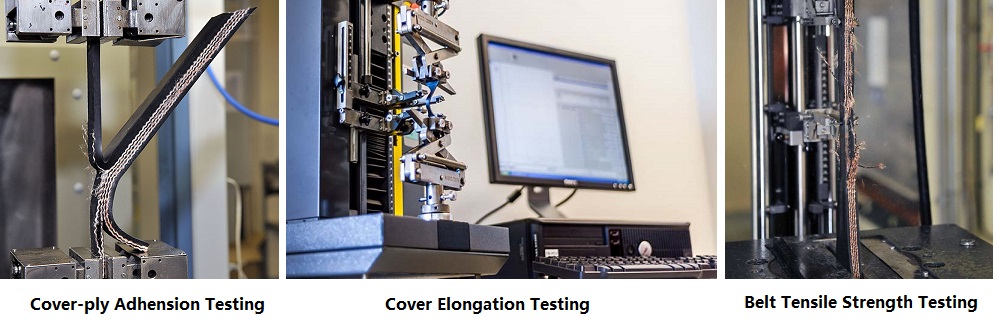
ISO 34-1 evaluates the tear strength of vulcanized rubber using different specimen configurations, including trouser, angle, and crescent test pieces.
The result is generally expressed in kN/m.
This test is useful for evaluating the quality of the rubber cover compound. However, it does not directly measure the longitudinal rip resistance of a complete conveyor belt.
ISO 505: Tear Propagation Resistance
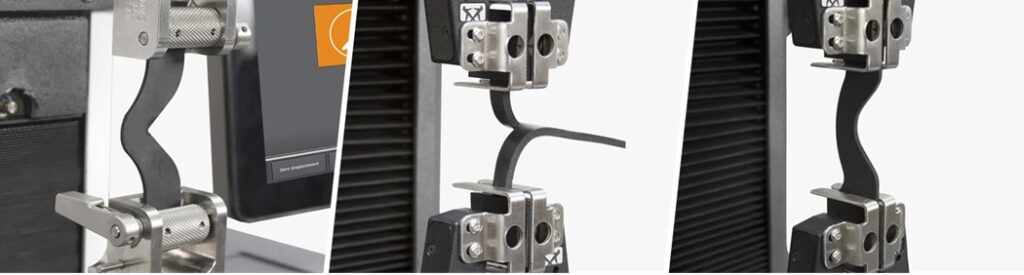
ISO 505:2025 specifies a method for determining the tear propagation resistance of textile conveyor belts.
The test uses a specimen with a pre-existing cut. A tensile force is applied to determine the resistance to further crack propagation.
Testing can be conducted on the complete belt thickness or on the textile carcass after removing the rubber covers. These results represent different test configurations and should not be compared directly.
Importantly, ISO 505 specifies the test method rather than a universal minimum acceptance value. Product requirements should be established in the purchasing specification.
Steel Cord Conveyor Belt Testing
Steel cord conveyor belts require additional consideration because their carcass consists of longitudinal steel cords embedded in rubber.
Although steel cords provide high longitudinal tensile strength, they do not automatically provide sufficient resistance to longitudinal ripping.
Transverse reinforcement, such as transverse steel cords or other reinforcing materials, can improve the belt’s ability to restrict crack propagation.
For coal mining applications, MT/T 668-2019 specifies crack resistance and impact penetration strength requirements for applicable flame-retardant steel cord conveyor belts.
The following table presents its relevant classification requirements:
| Test Item | Class A | Class B |
|---|---|---|
| Crack resistance | ≥3.0 kN | ≥10.0 kN |
| Impact penetration strength | ≥400 J | ≥1000 J |
These requirements apply within the scope of the specified standard. They should not be treated as universal acceptance requirements for all steel cord conveyor belts.
4. Main Factors Affecting Conveyor Belt Tear Resistance
The tear resistance of a conveyor belt depends on its rubber formulation, carcass construction, reinforcement design, and manufacturing quality.
4.1 Rubber Cover Compound
The rubber cover is the first protective layer against sharp materials and external impact.
Important factors include:
- Rubber type, such as NR, SBR, NBR, and EPDM.
- Carbon black type and loading.
- Vulcanization system and crosslink density.
- Rubber hardness and elasticity.
- Cover thickness and uniformity.
Natural rubber (NR) is widely used in heavy-duty mining conveyor belts because of its excellent elasticity and generally good tear resistance.
SBR can provide a useful balance of mechanical properties, while NBR is mainly selected when oil resistance is required.
Higher rubber hardness does not necessarily mean better tear resistance. The formulation must balance hardness, abrasion resistance, elasticity, and tear strength.
4.2 Conveyor Belt Carcass Structure
The carcass plays an important role in maintaining belt integrity after the rubber cover has been penetrated.
| Belt Type | Carcass Structure | Tear Resistance Characteristics |
|---|---|---|
| EP Conveyor Belt | Polyester warp and nylon weft | Good overall mechanical performance; crack propagation depends on fabric construction |
| NN Conveyor Belt | Nylon warp and weft | Good elasticity and impact absorption |
| Steel Cord Conveyor Belt | Longitudinal steel cords | High tensile strength but not automatically high longitudinal rip resistance |
| Rip Protection Conveyor Belt | Additional transverse reinforcement | Improved resistance to crack propagation |
For applications involving sharp rocks, iron ore, and severe impact, transverse reinforcement can provide additional protection.
The reinforcement may consist of transverse steel cords, textile breakers, or other engineered structures, depending on the belt design.
4.3 Manufacturing Quality and Adhesion
Even when high-quality rubber compounds and reinforcement materials are used, poor bonding between the cover rubber, core rubber, and carcass can weaken the overall structure.
Manufacturers should carefully control:
- Rubber-to-fabric and rubber-to-steel cord adhesion.
- Cover thickness and distribution.
- Rubber mixing uniformity.
- Vulcanization temperature, pressure, and time.
- Positioning and bonding of transverse reinforcement.
Consistent manufacturing quality is essential for maintaining reliable tear resistance throughout the belt’s service life.
5. Tear Resistance Test Results and Comparison
The following example illustrates how crack resistance and impact penetration strength can be evaluated against the requirements of MT/T 668-2019.
The measured values below are illustrative data for explaining test evaluation. They are not actual third-party laboratory results.
| Test Item | Class A Requirement | Example Result A | Class B Requirement | Example Result B |
|---|---|---|---|---|
| Crack Resistance (kN) | ≥3.0 | 3.45 | ≥10.0 | 10.85 |
| Impact Penetration Strength (J) | ≥400 | 465 | ≥1000 | 1080 |
| Crack Resistance Evaluation | Pass | Pass | Pass | Pass |
| Impact Strength Evaluation | Pass | Pass | Pass | Pass |
Analysis of Test Results
Crack Resistance
Class A achieves 3.45 kN, exceeding its minimum requirement of 3.0 kN. Class B achieves 10.85 kN, exceeding its minimum requirement of 10.0 kN.
A higher result indicates greater resistance to crack propagation under the specified test conditions.
Impact Penetration Strength
Class A achieves 465 J, while Class B achieves 1080 J. Both results exceed their respective requirements.
This test evaluates the belt’s ability to withstand impact penetration. It is different from measuring the force required to extend an existing crack.
Why Are Both Tests Important?
A conveyor belt may have good impact resistance but insufficient crack propagation resistance.
For example, a thick rubber cover may improve protection against local impact, but without adequate transverse reinforcement, a crack may still propagate along the belt.
Therefore, both properties should be considered when selecting conveyor belts for demanding mining applications.
6. How to Select a Conveyor Belt with Good Tear Resistance
The appropriate belt construction depends on the transported material, loading conditions, impact energy, and operating environment.
| Application | Recommended Belt Construction | Key Performance Requirements |
|---|---|---|
| General sand and gravel | EP fabric conveyor belt | Rubber tear strength and carcass integrity |
| Medium-sized ore transportation | Heavy-duty EP conveyor belt | Impact resistance, tear resistance, and adhesion |
| Large-scale iron ore transportation | Steel cord conveyor belt | Tensile strength and carcass protection |
| Sharp rocks and high-impact loading | Transversely reinforced conveyor belt | Crack resistance and impact penetration strength |
| Underground coal mining | Compliant flame-retardant conveyor belt | Tear resistance, flame resistance, and antistatic properties |
Before purchasing a conveyor belt, buyers should request the following information from manufacturers:
- Rubber cover tear strength tested according to ISO 34-1.
- Textile belt tear propagation resistance tested according to ISO 505.
- Details of transverse reinforcement for steel cord rip protection belts.
- Relevant crack resistance and impact penetration test reports where applicable.
- Clear identification of the specimen type and test method used.
It is also important to distinguish between laboratory material properties and the performance of a complete conveyor belt under actual operating conditions.
7. Conclusion
Tear resistance is a critical performance property affecting the reliability and service life of rubber conveyor belts.
For EP and NN fabric conveyor belts, rubber tear strength and tear propagation resistance are important indicators of material and structural performance.
For ST steel cord conveyor belts, high longitudinal tensile strength alone is not sufficient. Transverse reinforcement, crack resistance, and impact penetration strength should also be considered.
A high-quality rip-resistant conveyor belt should not only resist penetration and impact from sharp materials but also effectively restrict crack propagation after local damage occurs.
By selecting the appropriate rubber compound, carcass construction, transverse reinforcement, and manufacturing process, conveyor belt manufacturers can provide more reliable solutions for demanding mining, bulk material handling, and heavy-duty industrial applications.
Technical note: The numerical MT/T 668-2019 values are limited to the applicable coal-mine flame-retardant steel cord belt classification. The example test results are illustrative, not certified product data. ISO 34-1, ISO 505, and steel-cord belt test results should always be evaluated separately.
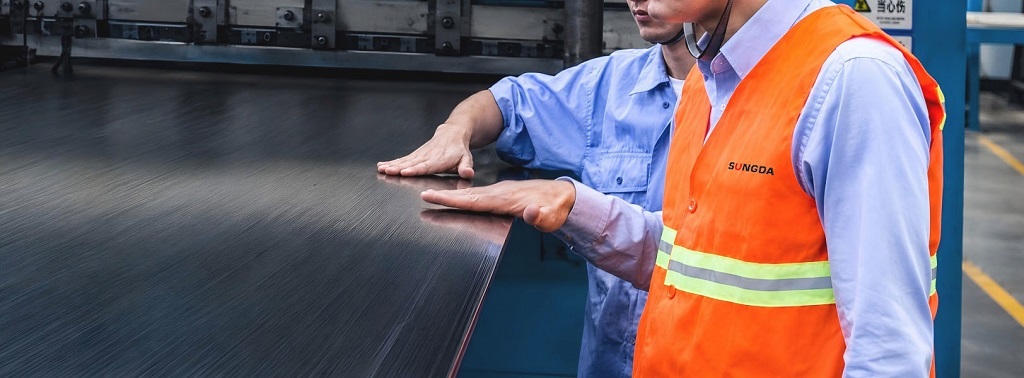
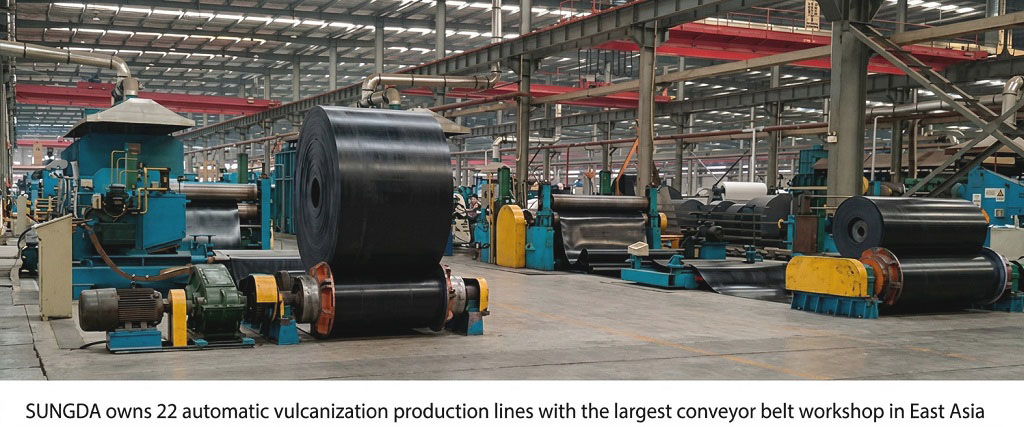
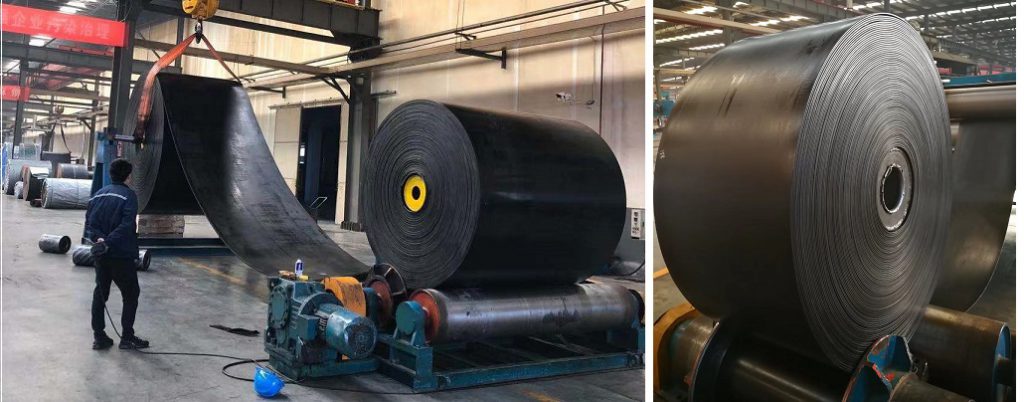
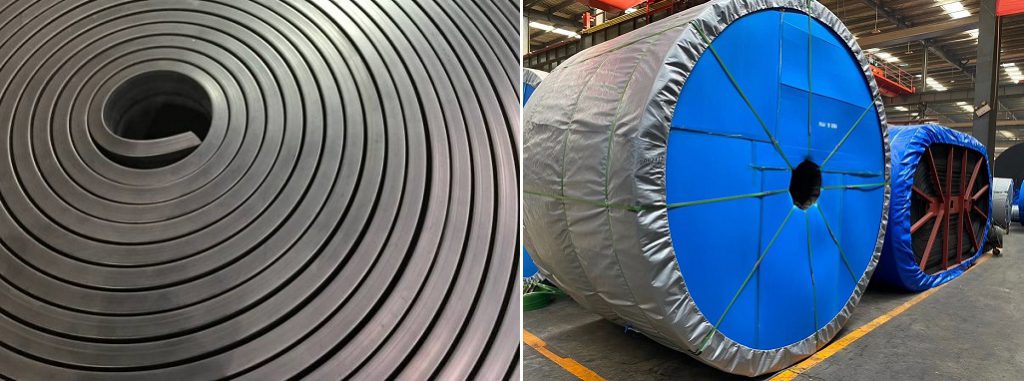
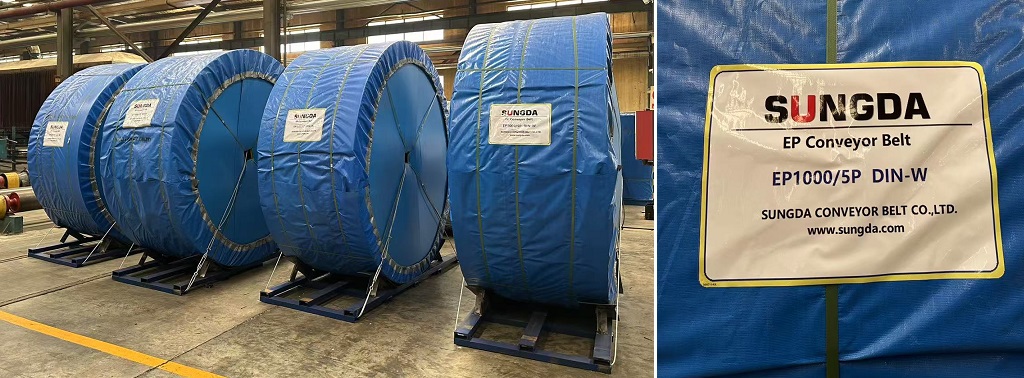
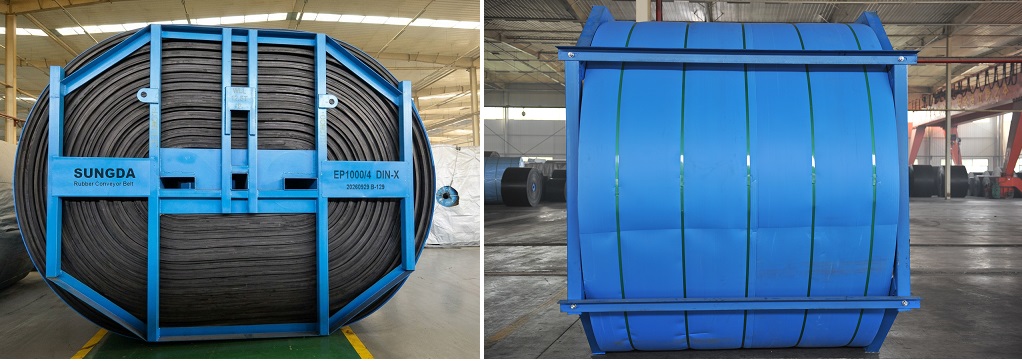
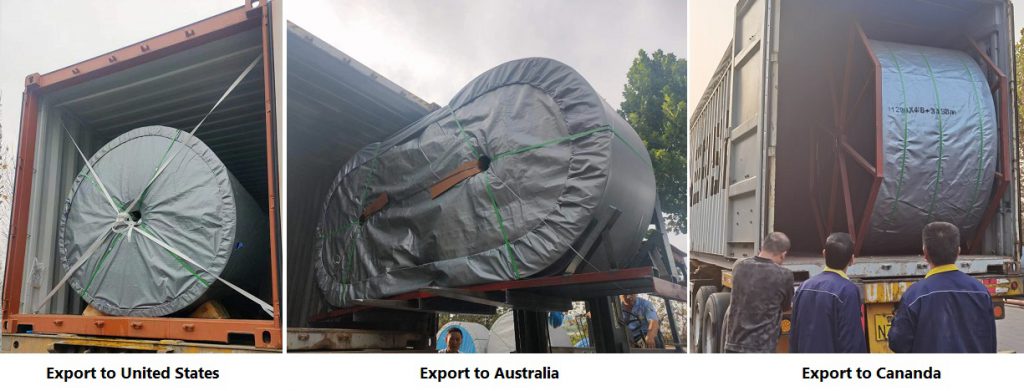
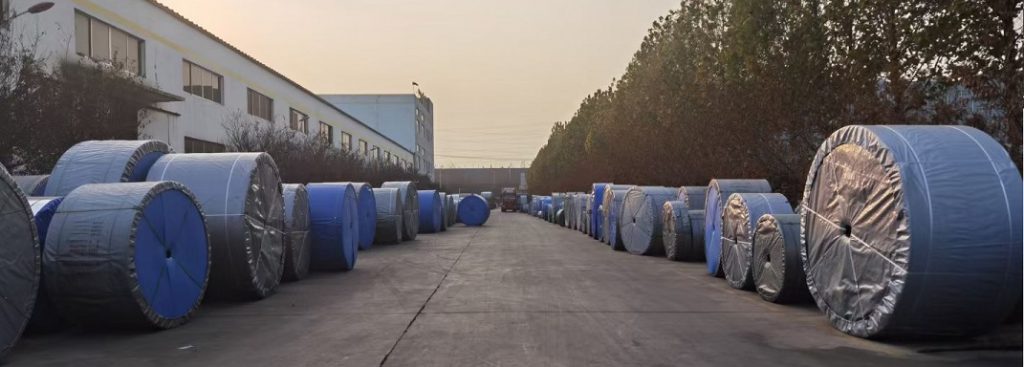
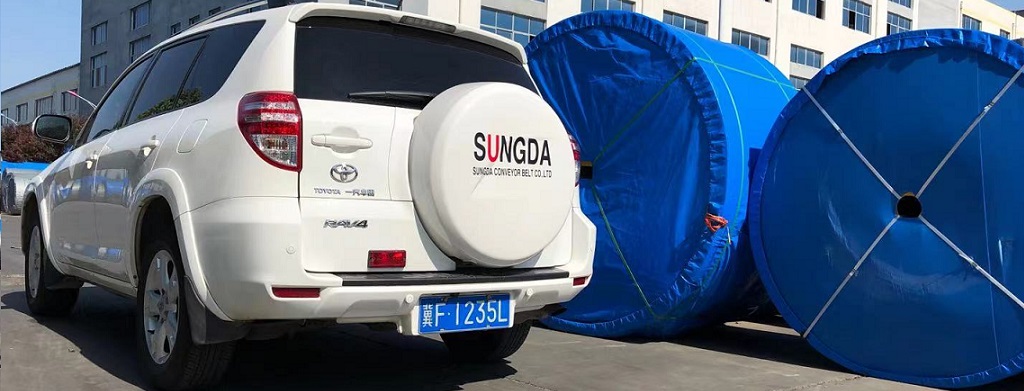
SUNGDA Conveyor Belt Vulcanization Workshop
Related Ep conveyor belt article:
- What are the advantages of EP conveyor belts compared to ordinary conveyors?
- How does the bending of EP fabric affect the working life of the conveyor belt?
- What is PIW in the EP conveyor belt and how to convert it into N/mm
- How to identify the quality of the EP conveyor belt in one minute?
Tags: conveyor belt maintenance,EP conveyor belt,Ep conveyor belt specification,heavy duty conveyor belt,Rubber conveyor belt,Steel cord conveyor belt,tear resistance
Related Products
-
How to Correctly Select ”Tensile Strength”, ”Elongation”, ”Abrasion”, and ”Tear Resistance” for Conveyor Belt?
No. -
How to Choose the Right Oil-resistant Conveyor Belt?
No. -
What Is Conveyor Belt Tensile Strength and Elongation at Break?
No. -

What Are AS, ASTM, and ISO Standards for Rubber Conveyor Belts?
No. -
How to Correctly Select EPDM, SBR, and NBR Rubbers for Conveyor Belts?
No. -
What is the adhesion strength of a conveyor belt?-SUNGDA
No. -
EP Conveyor Belt EP400/3,EP500/4,EP630/4,EP800/4-SUNGDA GROUP
No. -
How to Convert PIW Conveyor belt to EP Belt?
No. -
7 Common Causes of Conveyor Belt Tearing and What are the Preventive Measures?
No. -
The Top 5 Rubber Conveyor Belt Manufactures in China 2026(with website & contact info)
No.