



-
Product Categories
-
Featured Products
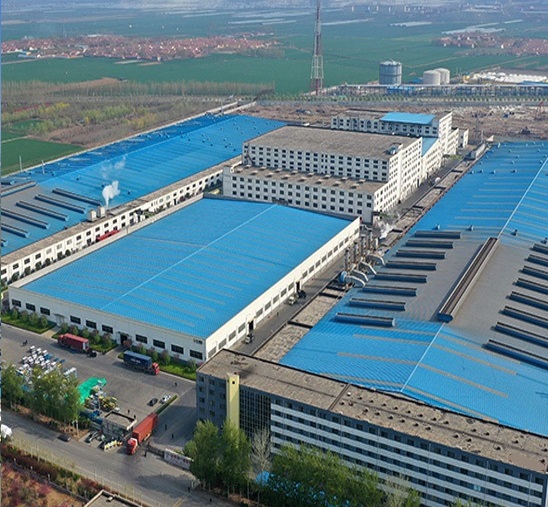
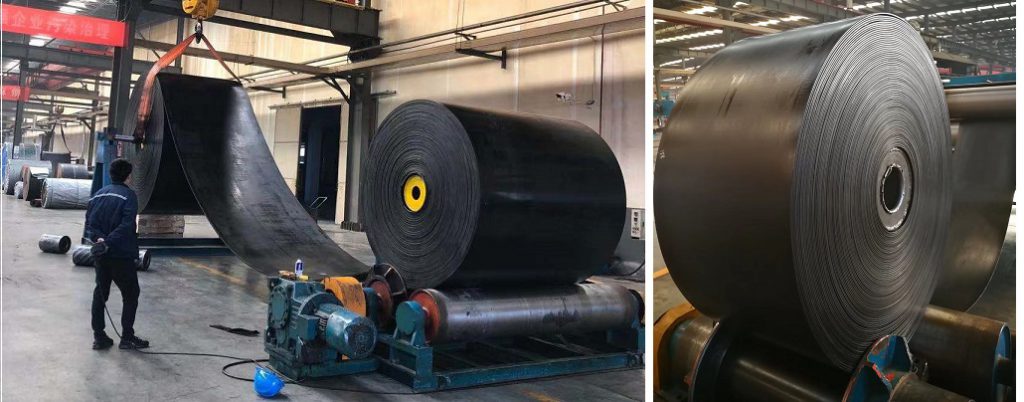
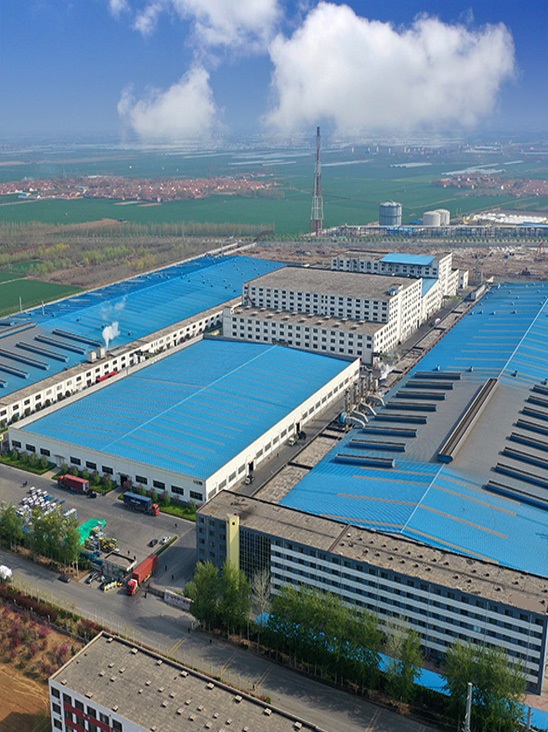
SUNGDA FACTORY AREA
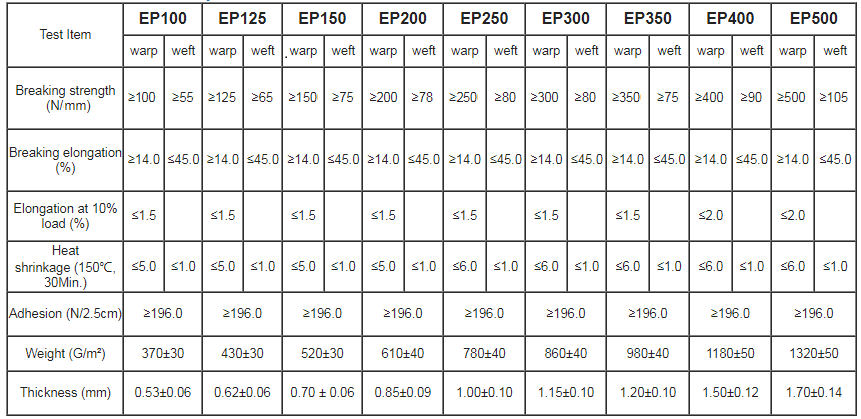
The Main Technical Specifications of EP Conveyor Belt
What is an EP rubber conveyor belt?
EP rubber conveyor belts, also known as polyester canvas conveyor belts, have an EP core consisting of polyester fiber in the warp and nylon fiber in the weft. They are widely used fabric-core rubber conveyor belts.
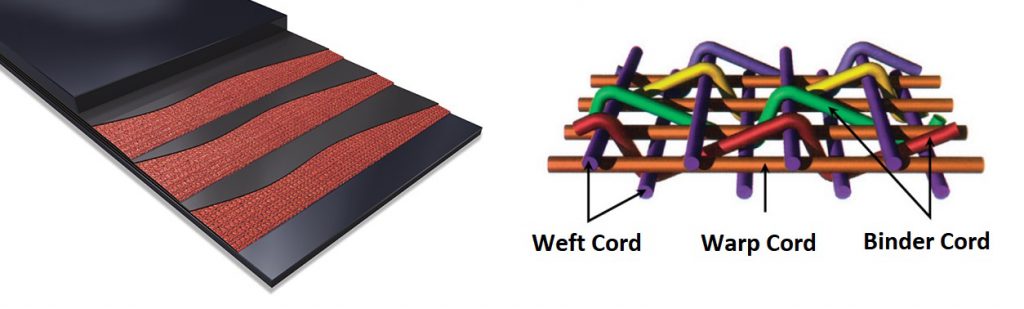
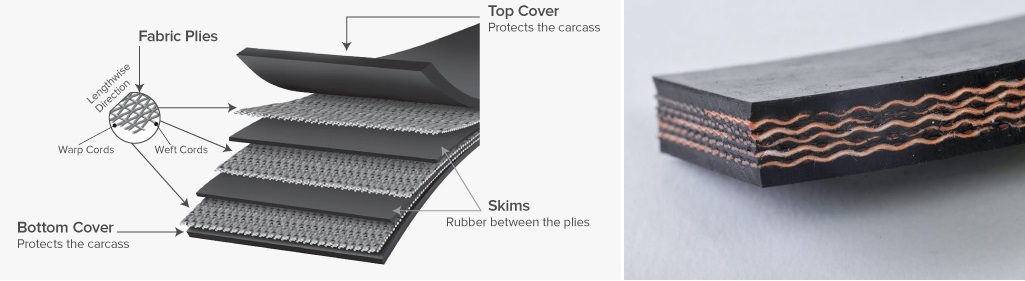
Structure: Three-layer composite structure. ① Upper and lower rubber cover layers: The upper layer is wear-resistant and impact-resistant, while the lower layer protects the belt body and reduces roller friction; ② Middle core (skeleton): Multiple layers of EP-impregnated canvas are stacked, with the polyester in the warp bearing longitudinal tensile force and the nylon in the weft ensuring lateral flexibility; ③ Rubber bonding layer: This tightly bonds the canvas and rubber, preventing delamination.
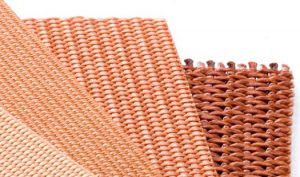
Features: Low longitudinal elongation, less prone to stretching during long-term operation, eliminating the need for frequent tension adjustments; high initial modulus, good dimensional stability, and superior heat resistance compared to nylon (NN) conveyor belts; excellent troughing properties, less prone to spillage; moisture resistant, with minimal strength loss after moisture absorption; lightweight and thin belt body, high tensile strength, and smooth operation. Compared to NN conveyor belts, it has stronger tensile creep resistance; the disadvantage is slightly weaker lateral impact resistance compared to all-nylon conveyor belts.
Applications: Suitable for medium- to long-distance, high-capacity, and high-speed continuous conveying of bulk materials. Widely used in mines, coal mines, cement plants, power plants, ports, sand and gravel aggregates, and metallurgical industries for conveying lumpy and granular materials such as ores, coal, sand, gravel, clinker, and slag. Special models with heat resistance, flame retardancy, and wear resistance can be made to suit open-air and humid factory conditions. It is mainly used in long-distance fixed conveyor lines and is a general-purpose conveyor belt in industrial and mining applications.
The common EP conveyor belt type could be:
2-ply belts: 315/2 400/2 500/2 630/2 800/2
3-ply belts: 500/3 630/3 800/3 1000/3 1250/3
4-ply belts: 630/4 800/4 1000/4 1250/4 1600/4
5-ply belts: 800/5 1000/5 1250/5 1600/5 2000/5
EP Fabric Technical Specification:
Muti-ply EP Fabric Grade (Tensile Strength kg/cm, PIW):
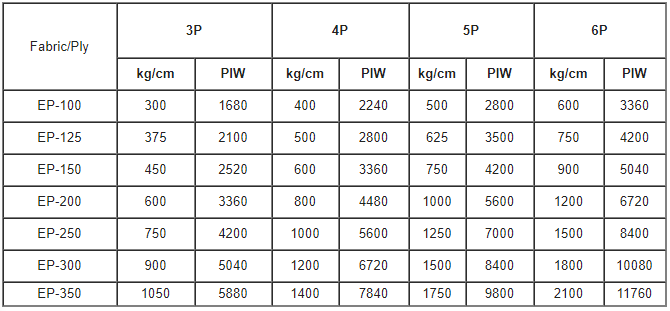
* PIW=Pounds Per Inch Of Belt Width
If you are from the U.S or Europe, you may need to convert between PIW with N/mm, please click here to see how to convert it.
The Top 5 Rubber Conveyor Belt Manufactures In China 2026
How to choose crushing plant conveyor belt for 100 ~ 1000T/H scale?
EP conveyor belt layer is the more the better?
How to choose the cover thickness of conveyor belt?
Rubber Cover Grade for EP Conveyor Belt
DIN22102 Standard:
| Standard | DIN-W | DIN-X | DIN-Y | DIN-Z | ||
| Tensile test | Before Aging | Tensile Strength (Mpa) | >18 | >25 | >20 | >15 |
| Elongation(%) | >400 | >450 | >400 | >350 | ||
| After Aging | Change rate of TS(%) | ±25 | ±25 | ±25 | ±25 | |
| Change rate of EL(%) | ±25 | ±25 | ±25 | ±25 | ||
| Abrasion test(mm³) | <90 | <120 | <150 | <250 | ||
AS-RMA Standard
| Standard | AS-N | AS-M | AS-A | RMA-I | RMA-II | ||
| Tensile test | Before Aging | Tensile Strength (Mpa) | >17 | >24 | >17 | >17 | >14 |
| Elongation(%) | >400 | >450 | >400 | >450 | >400 | ||
| After Aging | Change rate of TS(%) | ±20 | ±20 | ±20 | ±25 | ±25 | |
| Change rate of EL(%) | ±20 | ±20 | ±20 | ±25 | ±25 | ||
| Abrasion test(mm³) | <200 | <125 | <70 | <150 | <200 | ||
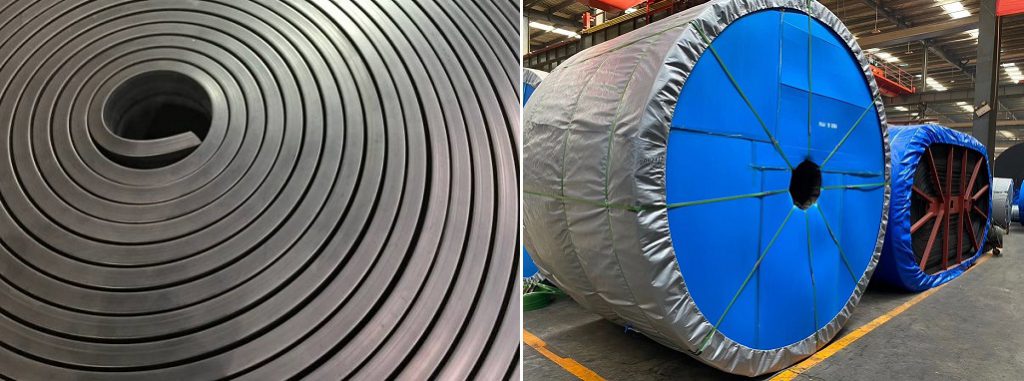
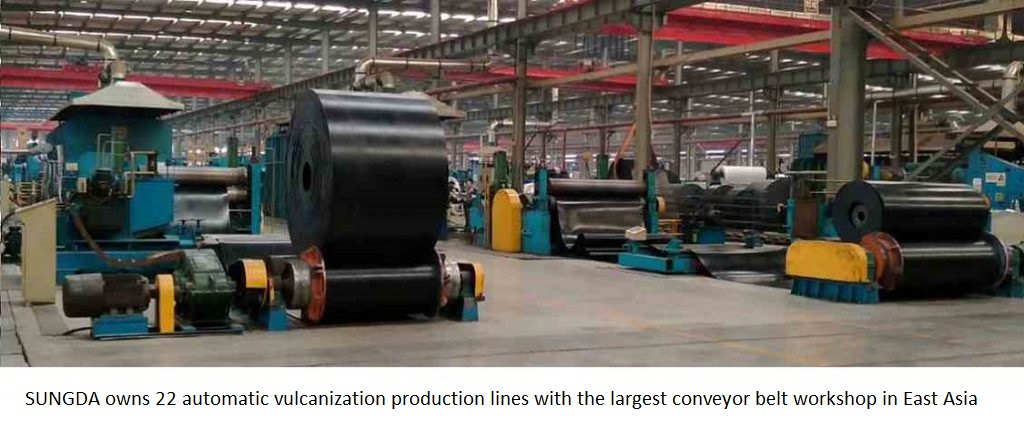
SUNGDA Conveyor Belt Vulcanization Workshop

Tags: Abrasion resistance of EP conveyor belts,Advantages and features of EP conveyor belts,aggregate ep conveyor belt,anti-static properties of ep conveyor belt,Applications and industries of EP conveyor belts,Bulk material ep conveyor belt,Buying guide for EP conveyor belts,Cement ep conveyor belt,Chemical resistance of ep conveyor belt,Chemical resistance of EP conveyor belts,coal ep conveyor belt,Comparison of EP conveyor belts with other types,conveyor belt specification,crushing plant ep conveyor belt,Ep conveyor belt specification,Ep fabric conveyor belt,EP rubber conveyor belt,ep1000/3 conveyor belt,ep1000/5 conveyor belt,ep1250 conveyor belt,ep1250/4 conveyor belt,ep1250/5 conveyor belt,ep160 conveyor belt,ep250 conveyor belt,ep315/2 conveyor belt,ep315/3 conveyor belt,ep400 conveyor belt,ep400/3 conveyor belt,ep630 conveyor belt,EP630/4 conveyor belt,ep800/3 conveyor belt,ep800/4 conveyor belt,ep800/5 conveyor belt,Installation and commissioning tips for ep conveyor belt,internation standards for ep conveyor belt,International standards and certifications for EP conveyor belts,Maintenance and care for EP conveyor belts,Manufacturers of EP conveyor belts,mining EP conveyor belt,polyester conveyor belt,Pricing and cost of EP conveyor belts,quarry ep conveyor belt,Reliability and durability of EP conveyor belts,Rubber conveyor belt,specification,steel plant ep conveyor belt,Temperature range for EP conveyor belts,tensile strength of ep conveyor belt,Tensile strength of EP conveyor belts,Waterproof properties of EP conveyor belts
Related Products
-
What are the Basic Indicators that Determine the Quality of Conveyor Belts?
No. -
What Are the Tensile Strength and Elongation in Rubber Conveyor Belts?
No. -
What’s “kg/cm²” in Conveyor Belt and How Convert it into other Units?
No. -
What is the difference between PSI and Mpa in conveyor belts and how to convert them to each other?
No. -
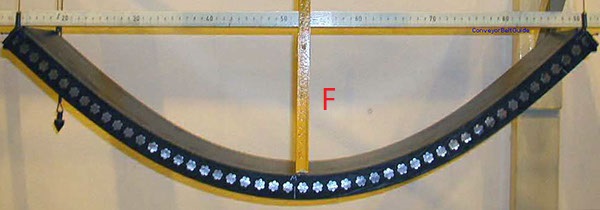
How to conduct conveyor belt troughing test
No. -
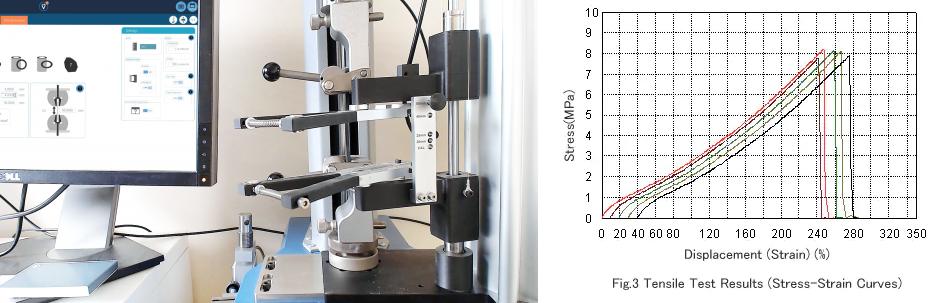
The Most Comprehensive National and Organizational Conveyor Belt Testing Standards
No. -
What are the chemical properties of various rubber components in rubber conveyor belts?
No. -
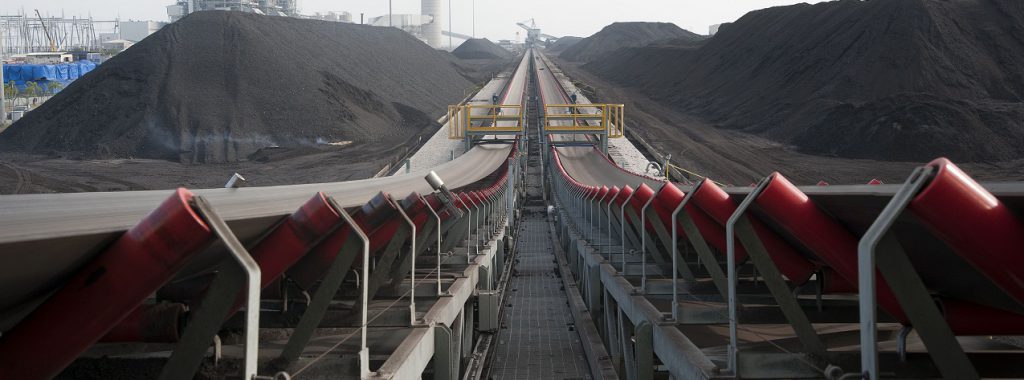
How to reasonably design long-distance conveyor lines
No. -
The 4 most critical tips for choosing the right rubber conveyor belt
No. -
How to increase the service life of rubber conveyor belts
No.