



Why EP conveyor belts are the most widely used in the world
The EP fabric layered conveyor belt is suitable for transporting various block, granular and large and medium items under general conditions. EP layered fabric core conveyor belt has now served many mines, power, building materials, coal, ports, metallurgy, chemical industry at home and abroad These fields have high corrosion resistance and abrasion resistance and long service life, so they are used in harsh environments such as underground transportation.
1.Small elongation
The EP fabric structure of the EP fabric layered conveyor belt is made of polyester-cotton fiber in both the warp and weft directions, with low elongation and good adhesion. The deformation is small under high temperature conditions, suitable for short distances and small conveyances. The conveyor belt is a quality upgrade product of cotton layer conveyor belts. Its tensile body is made of warp blended and weft cotton fibers. The performance is better than the cotton layer conveyor belt, especially the belt body is thinner and lighter, and the impact resistance is greatly improved. It is suitable for conveying materials under short distance and medium load conditions
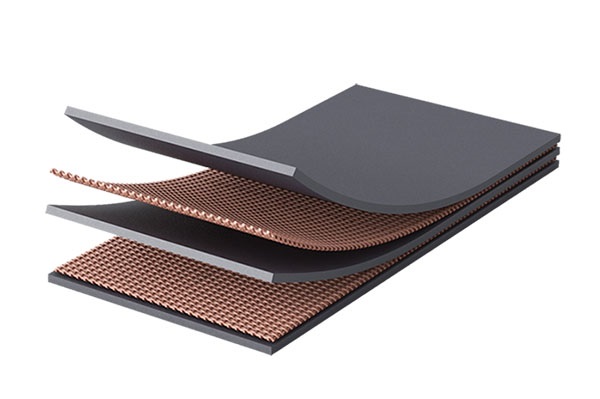
2.the EP material is light and thin
EP fabric layered conveyor belt. The EP fabric structure is woven with polyester-cotton fiber in the warp and weft directions, with low elongation and good adhesion. The deformation is small under high temperature conditions, suitable for short distances and small materials. The conveyor belt is a quality upgrade product of cotton layer conveyor belt. Its tensile body is made of warp blended and dimensional cotton fibers. The performance is better than the cotton layer conveyor belt, especially the belt body is thinner and lighter, and the impact resistance is greatly improved. It is suitable for conveying materials under short distance and medium load conditions.
3.High strength of EP fabric
EP fabric layered conveyor belts of different specifications and strengths are required to ensure material transportation under different working conditions, especially in the production of high-strength conveyor belts.
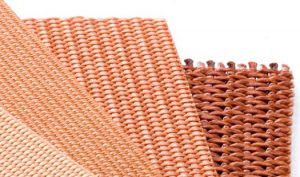
4.High-strength waveform EP fabric effectively absorbs impact
The high-strength corrugated EP fabric of the EP fabric layered conveyor belt can effectively absorb the loading impact and prevent the belt body from tearing. The fabric core layered conveying has good joint efficiency whether it is a vulcanized joint or a mechanical joint.
5.There are many options for the type and thickness of the cover rubber
For different applications, Anhui EP fabric layered conveyor with a variety of cover types and thicknesses to choose from.
| Carcass | No. of ply | Tensile strength (kgf/cm) | Tensile at break (kgf/cm) | PIW |
| EP160/2 | 2 | 16 | 160 | 89.6 |
| EP200/2 | 2 | 20 | 200 | 112.0 |
| EP250/2 | 2 | 25 | 250 | 14.0 |
| EP315/2 | 2 | 31.5 | 315 | 176.4 |
| EP400/2 | 2 | 40 | 400 | 224.0 |
| EP400/3 | 3 | 40 | 400 | 224.0 |
| EP500/2 | 2 | 50 | 500 | 280.0 |
| EP500/3 | 3 | 50 | 500 | 280.0 |
| EP630/2 | 2 | 63 | 630 | 352.8 |
| EP630/3 | 3 | 63 | 630 | 352.8 |
| EP630/4 | 4 | 63 | 630 | 352.8 |
| EP800/3 | 3 | 80 | 800 | 448.0 |
| EP800/4 | 4 | 80 | 800 | 448.0 |
| EP1000/3 | 3 | 100 | 1000 | 560.0 |
| EP1000/5 | 5 | 100 | 1000 | 560.0 |
| EP1250/3 | 3 | 125 | 1250 | 700.0 |
| EP1250/4 | 4 | 125 | 1250 | 700.0 |
| EP1250/6 | 6 | 125 | 1250 | 700.0 |
| EP1600/4 | 4 | 160 | 1600 | 896.0 |
| EP1600/5 | 5 | 160 | 1600 | 896.0 |
The following table is currently the main internationally popular conveyor belt implementation standards:
| Cover Grade | Country | Applicable Standards | Min.Tensile Strength(Mpa) | Min.Elongation at Break(%) | Max.Abrasion Loss(mm3) |
| DIN-Z | Germany | DIN22102 | 15 | 350 | 250 |
| DIN-Y | Germany | DIN22102 | 20 | 400 | 150 |
| DIN-X | Germany | DIN22102 | 25 | 450 | 120 |
| DIN-W | Germany | DIN22102 | 18 | 400 | 90 |
| RMA-I | U.S.A | RMA | 17 | 400 | 150 |
| RMA-II | U.S.A | RMA | 14 | 400 | 200 |
| ARPM RMA-I | U.S.A | ARPM | 17 | 400 | 125 |
| ARPM RMA-II | U.S.A | ARPM | 14 | 400 | 175 |
| ISO-L | International | ISO -10247 | 15 | 350 | 200 |
| ISO-H | International | ISO -10247 | 24 | 450 | 120 |
| ISO-D | International | ISO -10247 | 18 | 400 | 100 |
| AS-N | Australian | AS -1332 | 17 | 400 | 200 |
| AS-M | Australian | AS -1332 | 24 | 450 | 125 |
| AS-A | Australian | AS -1332 | 17 | 400 | 70 |
| SANS-N | South Africa | SANS-1173 | 17 | 400 | 150 |
| SANS-M | South Africa | SANS-1173 | 25 | 450 | 120 |
| SANS-A | South Africa | SANS-1173 | 18 | 400 | 70 |
| BS-M | UK | BS-490 | 24 | 450 | 120 |
| BS-N | UK | BS-490 | 17 | 400 | 200 |
| IS-N-17 | India | IS 1891 | 17 | 400 | 200 |
| IS-M-24 | India | IS 1891 | 24 | 450 | 150 |
| JIS-G | Japan | JIS-K 6332 | 14 | 400 | 250 |
| JIS-L | Japan | JIS-K 6332 | 15 | 350 | 200 |
| JIS-D | Japan | JIS-K 6332 | 18 | 400 | 100 |
| JIS-H | Japan | JIS-K 6332 | 24 | 450 | 120 |
| GB-H | China | GB/T 7984 | 24 | 450 | 120 |
| GB-D | China | GB/T 7984 | 18 | 400 | 100 |
| GB-L | China | GB/T 7984 | 15 | 350 | 200 |
10 Technical FAQs About Fabric (EP) Conveyor Belts for Heavy-Duty Conveying
1. How do I accurately calculate the required EP belt tension rating (EP Grade)?
Unlike steel cord belts, fabric belts are designated by their total carcass nominal breaking strength across all plies (e.g., an EP800/4 belt consists of 4 plies, each rated at 200 N/mm, yielding a total nominal breaking strength of 800 N/mm).
Selecting the correct EP grade requires evaluating the maximum belt tension (Tmax) under steady-state operating conditions and dynamic transients (starting and stopping):
Required Nominal Belt Strength (EP)≥Tmax /W x S0
(Where Tmax is the maximum belt tension in kN, W is belt width in meters, and S0 is the safety factor).
For multi-ply fabric belts, static and dynamic safety factors (S0) typically range from 10:1 to 12:1 under standard CEMA / DIN 22102 design rules to account for ply-to-ply load distribution variations and mechanical fastener or vulcanized splice efficiency.
Typical DIN/ISO-Type Fabric Belt Specifications:
| EP Designation | Number of Plies | Individual Ply Rating | Total Nominal Strength | Max Recommended Working Tension (Tperm)* |
| EP400/3 | 3 | 133 N/mm | 400 N/mm | ~40 N/mm |
| EP500/4 | 4 | 125 N/mm | 500 N/mm | ~50 N/mm |
| EP630/4 | 4 | 157 N/mm | 630 N/mm | ~63 N/mm |
| EP800/4 | 4 | 200 N/mm | 800 N/mm | ~80 N/mm |
| EP1000/5 | 5 | 200 N/mm | 1,000 N/mm | ~100 N/mm |
| EP1250/5 | 5 | 250 N/mm | 1,250 N/mm | ~125 N/mm |
*Based on a standard 10:1 working safety factor; actual allowable tension varies depending on joint type (vulcanized vs. mechanical).
2. What makes EP (Polyester/Polyamide) superior to NN (Nylon/Nylon) fabric belts?
Understanding fabric composition is essential for avoiding premature belt stretch and tracking failures:
Warp Fabric (Polyester / E): Runs longitudinally along the conveyor length. Polyester provides an exceptionally low dynamic elongation (typically <1.5% at nominal working load), which drastically reduces take-up stroke requirements compared to Nylon warp fabric.
Weft Fabric (Polyamide / P): Runs transversely across the belt width. Polyamide (Nylon) provides superior transverse flexibility, impact resistance, and mechanical fastener retention.
Compared to NN belts (Nylon warp and weft), EP belts exhibit lower operational stretch, higher resistance to moisture and mold, and superior thermal stability, making them the industry standard for medium-to-long distance bulk material handling.
3. Is more plies always better for heavy-duty applications?
No. Increasing the number of plies adds total tensile strength, but over-plying causes severe mechanical disadvantages:
1.Reduced Troughability: Excessively thick, multi-ply belts become overly stiff across their width, preventing proper contact with the center idler when empty and leading to severe mistracking.
2.Increased Minimum Pulley Diameters: Additional plies increase the total carcass thickness (e), raising inter-ply shear stress during bending. An EP1000/5 belt requires significantly larger pulleys than an EP1000/3 belt to prevent ply separation.
3.Higher Bending Fatigue: Repeated flexure over small drive pulleys causes inter-ply delamination over time.
Engineering best practice dictates choosing fewer plies with higher individual ply ratings (e.g., EP800/3 instead of EP800/5) to maximize troughability and reduce bending stress.
4. What is the realistic service life expectation for an EP conveyor belt?
Engineering life assessments must decouple Carcass Fatigue Life from Cover Rubber Wear Life:
EP Fabric Carcass: Under normal continuous operation, an EP carcass is engineered for a 5 to 10-year fatigue design life. Unlike steel cords, synthetic fibers experience gradual flexural fatigue and moisture aging.
Top/Bottom Covers: Cover wear is governed by material lump size, sharp edges, drop height at transfer points, and loading frequency. In heavy mining or aggregate crushing, top covers may wear down in 2 ~ 4 years, requiring cold-bonding repair or re-covering while the EP core remains structurally sound.
5. What are the key troughability and pulley diameter limits for EP belts?
Belt troughability must be verified against idler angle (20℃, 35℃, or 45℃) to ensure the unladen belt molds into the idler trough. Minimum drive pulley diameters (DA) per DIN 22102 are governed by total carcass thickness and stress levels:
| EP Designation | Carcass Thickness (Approx.) | Min. Drive Pulley DA (100% Load) | Min. Troughability Width (35∘ Idlers) |
| EP400/3 | ~3.6 mm | 315 mm | 500 mm |
| EP630/4 | ~4.8 mm | 400 mm | 650 mm |
| EP800/4 | ~5.2 mm | 500 mm | 800 mm |
| EP1000/5 | ~6.5 mm | 630 mm | 1,000 mm |
| EP1250/5 | ~7.2 mm | 800 mm | 1,200 mm |
Procurement Warning: Installing an EP1000/5 belt on a system designed with 400 mm pulleys will cause rapid inter-ply delamination within months of commissioning.
6. Hot Vulcanized, Cold Bonded, or Fastened: Which splice method should be specified?
The choice of joint method directly determines allowable working tension and system reliability:
Hot Vulcanized Splices (Efficiency: 85% – 90%): The gold standard for permanent installations. Uses step-matching ply techniques under heat and pressure. Required for high-tension EP belts (≥EP630).
Cold Bonded Splices (Efficiency: 70% – 80%): Uses specialized two-part cement at ambient temperatures. Ideal for underground or hazardous locations where hot vulcanizing presses cannot be operated.
Mechanical Fasteners (Efficiency: 50% – 65%): Plate or wire-hook fasteners offer rapid repair times but create stress concentrations and wear out scrapers. Recommended only for temporary applications, low-tension short runs, or emergency repairs.
7. How do I select the right cover rubber grade (DIN 22102 / ISO 10247)?
The rubber cover protects the load-bearing EP carcass from impact, abrasion, and environmental degradation. Standard cover grades are categorized by mechanical properties:
Grade W (ISO ‘D’): Premium abrasion resistance (≤90mm3loss). Recommended for highly abrasive materials like quartz, iron ore, and heavy sinter.
Grade X (ISO ‘H’): Balanced high abrasion and cut/gouge resistance (≤120mm3 loss). Ideal for large lump limestone, granite, and sharp metallic ores.
Grade Y (ISO ‘L’): Standard duty abrasion resistance (≤150mm3 loss). Suited for coal, sand, gravel, and general bulk materials.
Special Duty Compounds: Heat-resistant (HR / HRT up to 200°C), Oil-resistant (OR), and Flame-retardant (FR) formulations must be specified if chemical, thermal, or underground safety criteria apply.
8. What causes ply delamination, and how can it be prevented during procurement?
Ply delamination—the separation of adjacent fabric plies—is the leading cause of premature fabric belt failure. It is caused by:
Insufficient Inter-Ply Adhesion Strength: Low rubber-to-fabric bond strength during manufacturing.
Excessive Bending Stress: Running the belt over undersized pulleys or reverse bends.
Because synthetic fabrics exhibit higher elastic and permanent elongation than steel cords, gravity or hydraulic take-up units require significantly longer travel distance:
Chemical / Oil Ingress: Hydrocarbons or chemicals penetrating edge cuts and dissolving the skim rubber layer.
Procurement Rule: Always specify Inter-Ply Peel Strength ≥4.5N/mm (per ISO 252 testing) and ensure full rubber-sealed edges (Molded Edges rather than Cut Edges) for wet or chemically aggressive environments.
9. How does take-up travel calculation differ between EP belts and steel cord belts?
Take-Up Travel Allowance≈1.5%~ 2.5%) x Conveyor Center Distance
EP Belts: Require approximately 1.5~2.0% of total center distance in take-up stroke (e.g., a 200 m conveyor needs 3.0~4.0m of take-up travel).
Comparison with NN Belts: NN belts require up to 3.5% ~ 4.0% travel stroke, whereas Steel Cord belts require only 0.2% ~ 0.5%.
If take-up space is physically constrained on an existing structure, retrofitting from NN to EP—or specifying a high-modulus low-stretch EP weave—is mandatory to prevent take-up carriage bottoming out.
10. How should condition monitoring be conducted on fabric EP conveyor belts?
Unlike steel cord belts, which rely on electromagnetic scanners, multi-ply EP belts require a combination of visual, mechanical, and ultrasonic diagnostics:
Cover Thickness Ultrasonic Profiling: Non-destructive ultrasonic gauges measure remaining top and bottom cover rubber over time to schedule re-topping or replacement.
Visual & Thermographic Joint Monitoring: Infrared cameras detect anomalous heat buildup at splices caused by internal ply friction or dynamic joint slip prior to separation.
Automated Edge Inspection: Optical sensors monitor edge wear and ply fraying caused by structure rubbing, catching tracking issues before moisture penetrates the internal carcass.
Transitioning from time-based replacement to state-of-the-art condition-based monitoring ensures maximum tonnage throughput while eliminating catastrophic carcass snaps.
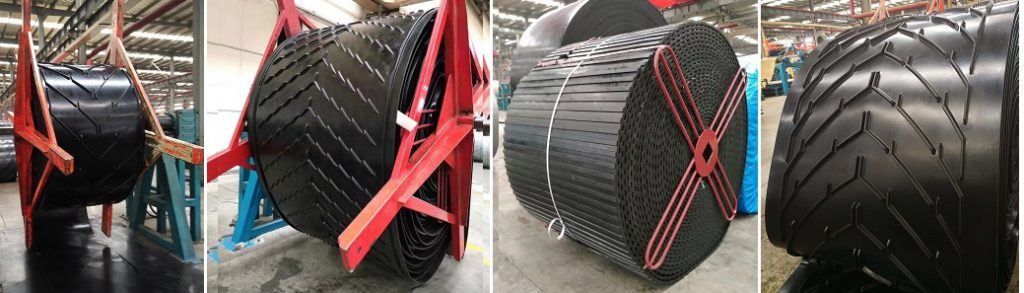
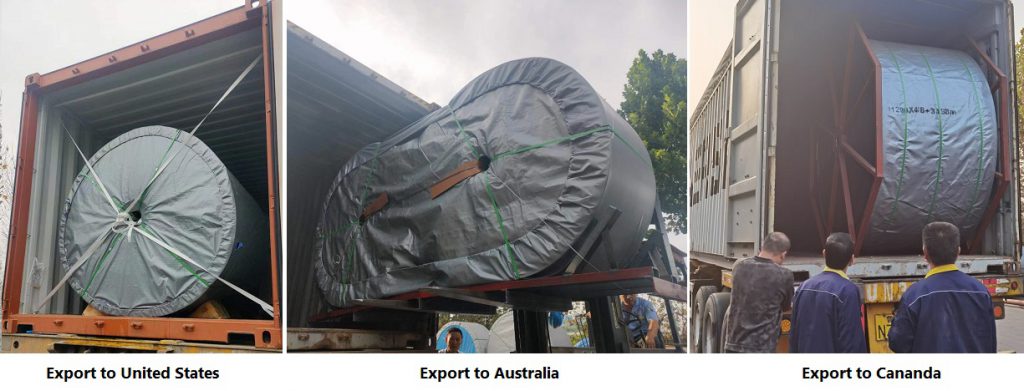
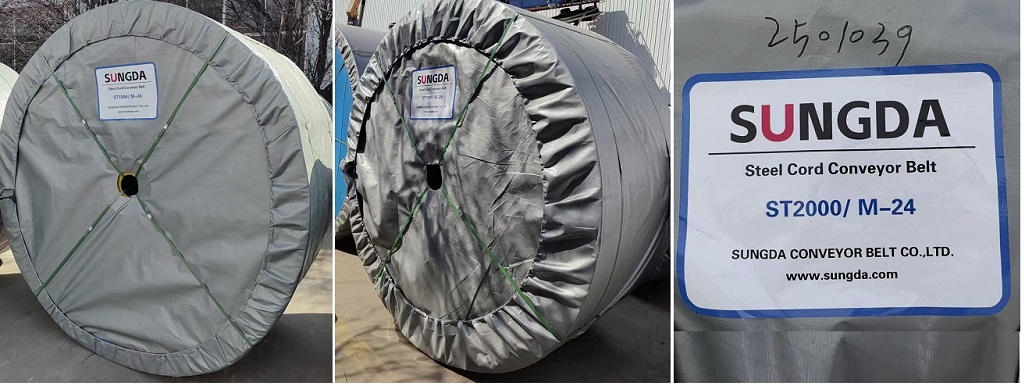
SUNGDA Conveyor Belt Vulcanization Workshops
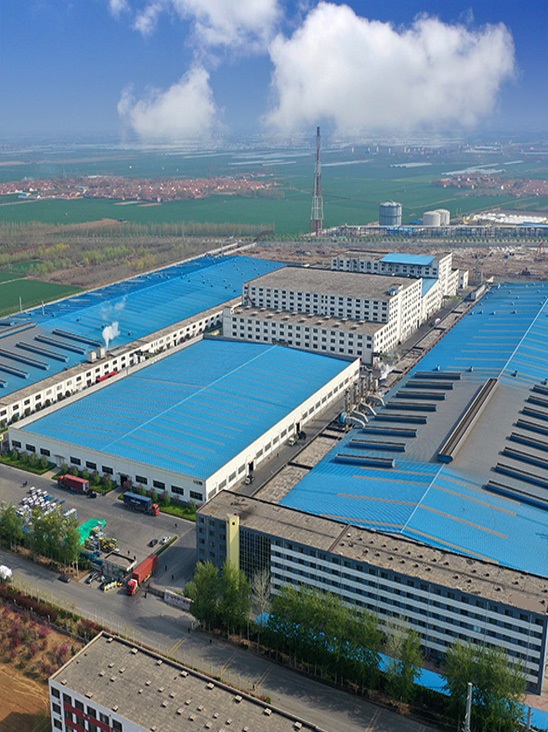
SUNGDA EP rubber conveyor belt series such as mining conveyor belt, heat resistant conveyor belt, and flame resistant conveyor belt adopt Continental conveyor belt technology, are developed to assure you of the high-quality rubber conveyor belt.
The combination of polyester in warp and nylon infilling provides technical low-stretch, high impact abuse resistance. Recommended for transporting abrasive materials, such as mining, rock, stone, ore, glass, granite, etc, for more information, please log on our website: https://www.sungdagroup.com or email us by info@sungdagroup.com
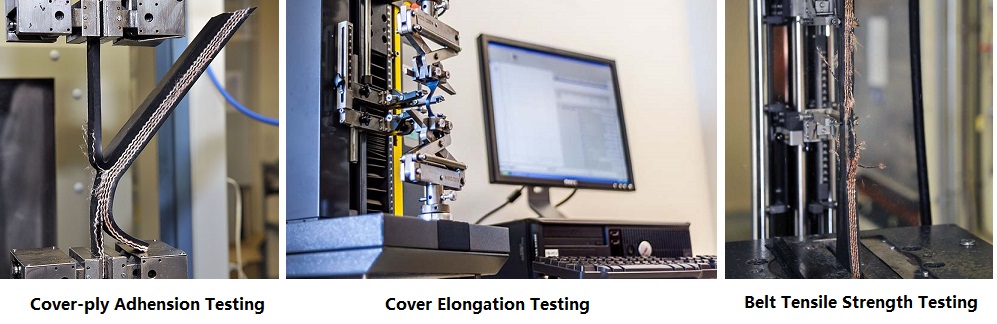
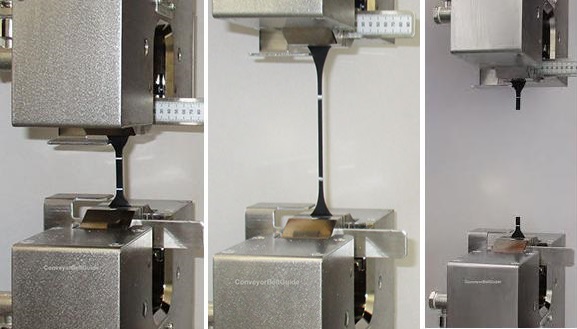
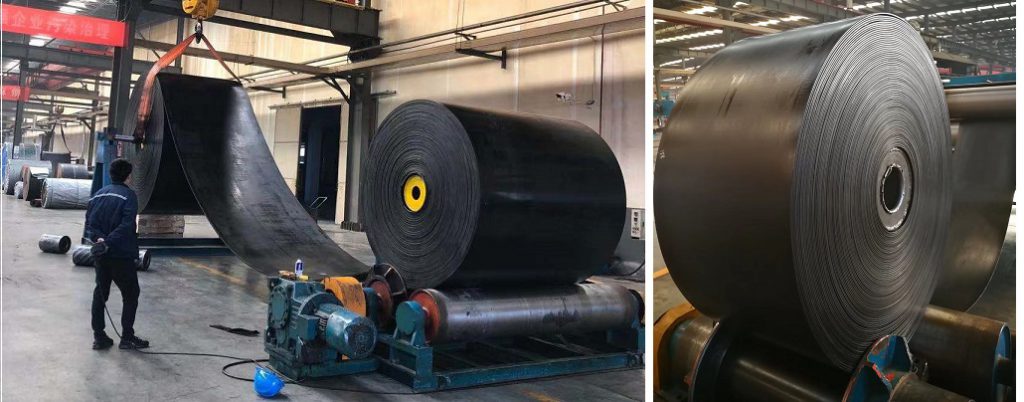
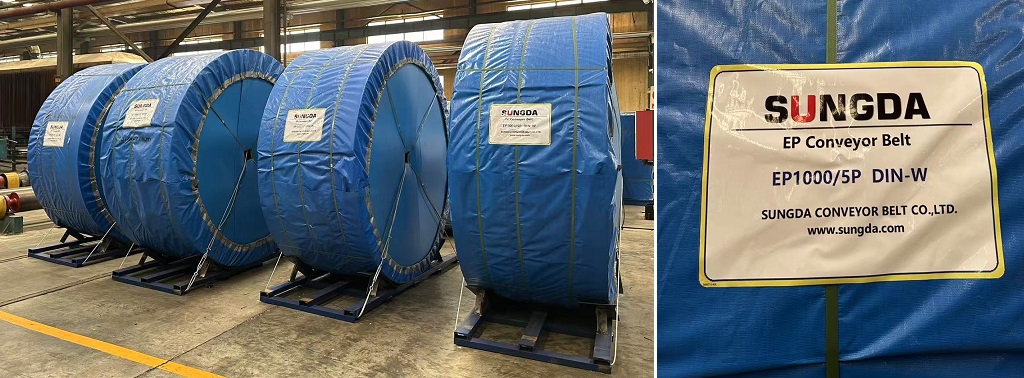
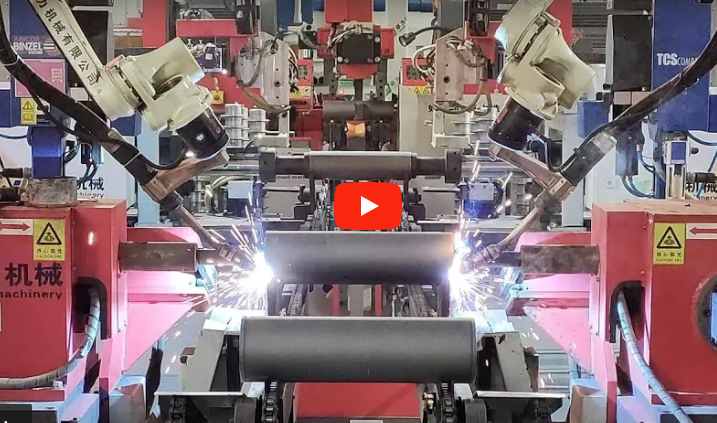
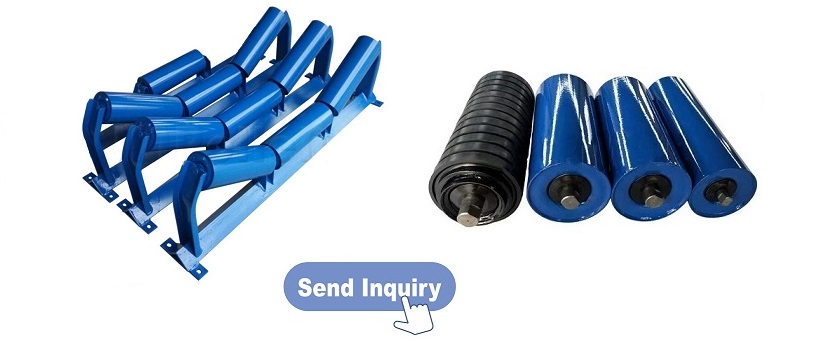
We also supply conveyor idler roller, pulley and conveyor bracket, please log to our branch company official website www.conveyoroller.com or click below picture for idler roller producing video.
Tags: EP conveyor belt,Ep conveyor belt specification,ep layer,EP rubber conveyor belt,EP630/4 conveyor belt,ep800/4 conveyor belt
Related Products
-
Material Composition of High-Quality Conveyor Belts (from ContiTech & Dunlop)
No. -
What are the Basic Indicators that Determine the Quality of Conveyor Belts?
No. -
What Are the Tensile Strength and Elongation in Rubber Conveyor Belts?
No. -
What Are the Key Properties of T1, T2, T3, T4 Heat-Resistant Conveyor Belts?
No. -
What’s “kg/cm²” in Conveyor Belt and How Convert it into other Units?
No. -

How to Calculate PIW of Conveyor Belt?
No. -
How to Convert PIW Conveyor belt to EP Belt?
No. -
How to Clean EP Conveyor Belt
No. -
Common causes and solutions for sagging of EP conveyor belts
No. -
What is the reasonable speed of the ep conveyor belt?
No.